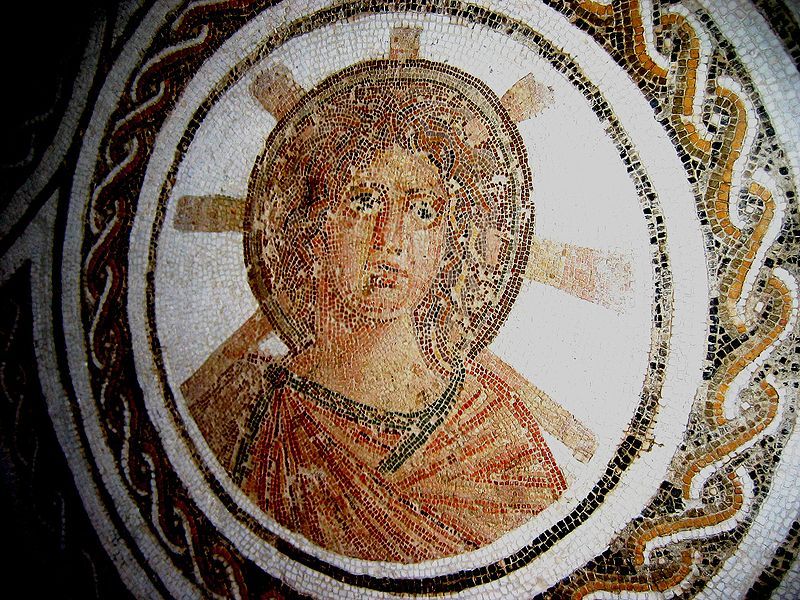
Solar Apollo with Helio's halo
“Apollo” (when we first see him in Homer and other early sources) is a god of archery, hunting, prophecy, lyre-music, and dancing. He is also god of cattle-herding and plague. He is never connected with the sun. And this stays almost entirely true in mythological texts until they end. How could a sun god sbe banished to earth for a year to serve as a cattle-herder at Troy and again in the sevice of King Admetus. Are we to imagine the sky without a sun for two years? Apollo is normally the son of Zeus by Leto. Prominent children ascribed to him are Trophonius, Amphiaraus, and Asclepius.
However in Greek religious belief (as opposed to mythological tradition) Apollo was increasingly connected or identified with the sun. Dionysos was also sometimes connected with the sun. Even Zeus was sometimes connected with the sun. But remember, by this time all educated people thought that the physical sun was a ball of fire that orbited a spherical earth, not a humanoid god in a chariot who rose every day from the east, descended in the west, and then sailed in a cup back to the east, as found in traditional mythology. Philosophers usually claimed to know nothing about the perfect gods, and the gods of tradition were explained as either famous mortals of early days who had been imagine as gods or were explained as daimons, that is a sort of lesser divine being, or were explained allegorically: Zeus was the sky, Hera was air, Hephaistos was fire, and so forth. Apollo usually ended up as the light or the sun.
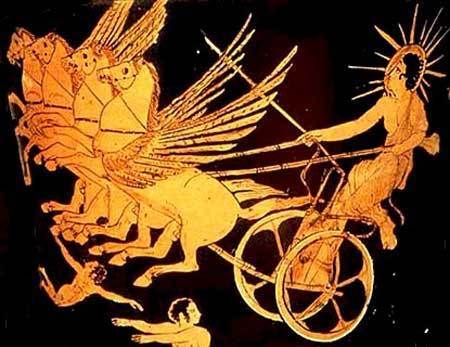
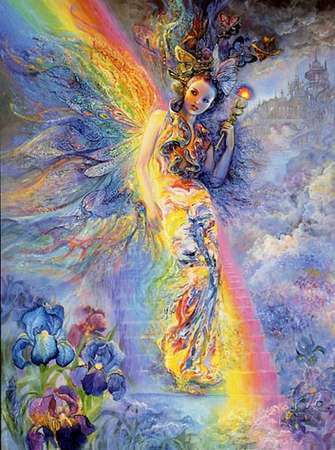
Everyday, Helios rides the chariot of the sun, to give light and heat to the world.
In Roman tradition, Helios was simply translated by the Latin word “Sol” meaning “Sun”. But this Sol was also sometimes called Phoebus, a Greek word meaning “Shining” which was also a traditional name for Apollo. Yet there is still no confusion. In Ovid’s “Metamorphoses' for example it is quite clear when Ovid is speaking about Phoebus the sun and when he is speaking about Phoebus Apollo. They are never identified with one another.
In classic Latin verse it was customary to refer to the sun as Phoebus in his car or chariot. Late medieval poets used the same trope. They seem, at least so far as I can tell, to know they are talking about Phoebus the sun-god, and not Phoebus Apollo. But one can’t always be sure, especially when ancient religious texts which connected Apollo with the sun were also common knowledge.
Despite this, the identification of Phoebus the sun god with Phoebus Apollo had become standard in Victorian times. One finds it in Bullfinch’s “Mythology” and in the story of “The Pomegranate Seeds” in Nathaniel Hawthornes’ “Tanglewood Tales”.
It also occurs iwrongly n some modern books, none of which ever provides a single passage in any mythological text which equates the chariot driving Helios of Rhodes, son of Hyperion and Theia with Apollo son of Zeus and Leto. Because no such passages are rare. I know of only two: one mention in a fragment of Euripides’ “Phaethon”, a play in which the speaker is actually named as Helios. This is the earliest example of a religious connection between sun god and Apollo. There is also a tradition found once that the legendary Orpheus claimed the sun as chief god and called him Apollo. But this is not confirmed in surviving Orphic documents.

Apollo is likely to be a reflex of an earlier archer god, cognate with the Hindu Rudra (now usually known as Shiva), the Semitic Reshpu/Reshep, and the Norse god Ullr. Shiva is an archer god like Apollo, and a god of buffalo, which fits with Apollo's connection with cattle. Shiva remains a hunter while Apollo is more connected with herding. While Apollo remains connected only with lyre music and dancing to the lyre (that is with stringed instruments related to the bow), Shive has taken over all music, including especially flute music to which Apollo remains hostile. Shiva, as the crescent moon on his forehead indicates, is connected to the moon. Apollo has become increasingly solar. He might have earlier been a lunar god.
One finds it hard to connect the presumably staid dancing of Apollo and the Muses with the presumed wild and orgiastic dancing of Shiva and his spirits. But perhaps the idea that Apollo and the Muses were staid comes more from “classic” interpretations than anything in the texts?
Both Apollo and Shiva are connected to hidden knowledge. In the case of Apollo this comes out a prophesy and a few statements like “Nothing in excess”. Shiva on the contrary seems to believe that everything should be in excess, including asceticism.
When Sol Invictus was, for a short time, made the head of the Roman pantheon, he seems not to have been particularly identified with Apollo.
Similarly Greek Artemis and Latin Diana had in mythological texts no connection to the moon goddes called by the Geek Selene and by the Roman Luna. It was Selene/Luna who continually embraced the sleeping shepherd Endymion, not Artemis/Diana.
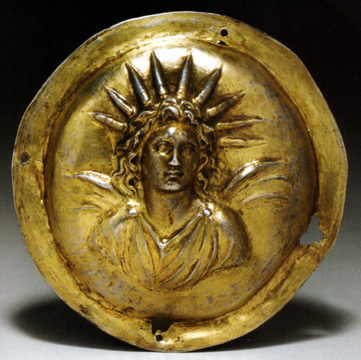
A golden image of Helios